and the reward of failure in the chemical industry is…… promotion!
Another tale of failed management, another tale of “Dr” Peter Bloore.
Quite why he was seemingly promoted to the role above in Albright and Wilson due to his absolute failures as works manager at Trinity Street is beyond me, but perhaps he was just so good at lying to the public that they thought he would fit the job.
These two separate incidents , again from his disastrous tenure at the helm as phosphorus commander both deal with a substance known as phosphorus sesquisulphide.
A short history lesson is needed about this substance, chemical formula P4S3, and Albright and Wilson’s manufacture of it, which started in 1898/99.
The dangerous use of white phosphorus matches paved the way for “safer” alternatives, with this yellow solid being one of the most well known. It wasn’t really “safe” because it still could catch fire very easily, due to the impurities of white phosphorus within it when the p4 was heated with sulphur. It’s reaction with water is also dangerous.
From “The manufacture and uses of phosphorus and some of its compounds”, we get the formula for the “strike anywhere” matches that used this chemical at 9%. Don’t try making any fiery explosions at home by following this formula now, yall 😀
This was without doubt a lucrative Albright and Wilson’s export line in the 20th Century. Some studies however by J. FREDERICK BURGESS show how the sesquisulphide of phosphorus can cause series dermatitis issues when handled with these type of match material.
“This poisoning resulted in a recurring severe primary dermatitis about the eyes and face. In each case, loosening of the teeth occurred which may have been due to phosphorus poisoning. In one case a severe systemic poisoning resulted which cleared up completely on discontinuing the use of matches.”
I’d suggest therefore that the term “non-toxic” is therefore another Albright and Wilson semantic argument which could be challenged. When it combusts, it forms sulphur dioxide and also phosphorus pentoxide, which Albright and Wilson have continuously lied about being non-toxic during their frequent off site releases.
As this post also shows, in the latter part of the century, they were still having problems with making it safely at POBox 80.
Two incidents within just a few weeks demonstrate how their farcical health and safety systems were not up to scratch. The first from 24th July 1989 Sandwell Evening Mail tells how firemen tackling a fire had to be “de-contaminated” after coming into contact with a fire involving the substance.
“The chemical is very dangerous when it dries out because it spontaneously combusts”
It is interesting to see that the fire commander also highlights the real prospect of carrying the drying solid off site and the potential for it to catch fire thereafter. The only comment from Dr phosphorus is that it was used in the production of matches- a typical Albright and Wilson Bloore statement which basically reads as an advertisement and never an explanation or apology.
Well strike a light, if the same thing didn’t happen just two months later!
The same paper reported another fire in its September 11th edition. On this occasion, firemen spent 3 hours putting that light out. A large amount of the substance had again caught fire, and one can only deduce from this is that it was not being stored safely.
Bloore promised an investigation, like these people always do, but the paper failed to link these two close incidents which is poor journalism to be honest. Whatever this “investigation” amounted to, the method of disposing of the mess would not be investigated. It was simply drummed up for disposal.
The statement about storing it in water appears to very dubious as this chemical produces toxic gases when doing so. We do know however that their Gower Tip licence SL32 allowed them to dispose of 2 tonnes a year of this substance at this site, as well as the linked phosphorus pentasulphide, and this tip was still in use at the time of this fire, indeed, the same firemen would be tackling a fire next to the Gower in the following year. and expressing concern at the exposed drums of chemicals dumped there 😆
This site is a former clay marl hole which has been used as an industrial tip since 1938. The site has received large quantities of toxic and hazardous waste since this time. These are mostly comprised of various compounds of phosphorus together with some radio-active wastes, laboratory chemicals, solvents etc. The site represents the major disposal outlet for the Company’s waste phosphorus pentasulphide and phosphorus susquisulphide.(sic)
These waste arisings are the main problem associated with this site since they are highly reactive especially with water. “
Of course, “the stuff used in matches” at The Gower tip remains buried there to this day.
Posted inUncategorized|Comments Off on Albright’s toxic archives #30 Bloore’s sesquisulphide mismatch
It never just rains over Langley, it rains toxic fumes and escaping gas from the terrorists based at PO BOX80. As the Sandwell Evening Mail reported on 7th December 1990, this capped an absolutely terrible year of accidents and environmental disasters for this company, and it can only have been as a result of the abysmal, incompetent and failed management.
50 tonnes of phosphorus are reported to have exploded at the Oldbury factory sending a cloud plume of toxic gas and vapour into the air, just as had happened at their Portishead plant earlier in the year. This incident is important as it shows the dangers of unloading this highly dangerous chemical from rail cars, like the situation that had occurred in Ohio with Another Albright and Wilson train wagon in 1986. It is interesting to note the copper’s statement about the escaping phosphorus situation.
“As it burns it gives off the toxic phosphorus pentoxide which causes irritation of the nose, eyes and throat.”
This is not what Albright and Wilson staff had categorically lied to the press and public about after the Portishead release, where they claimed that the gas given off, (phosphorus pentoxide) ,was not toxic.
The area around the plant was made “a no go area” after being cordoned off by the plod, as well as being on standby to evacuate homes . The two other tankers containing p4 also had to be removed to prevent any further explosion in a fire that was tackled by 60 firemen.
A company spokesman by the name “John Pickup” , who I must admit I have never heard of in all my long research of this disgusting company, (and I question if this is a misprint), claims that no lasting harm was caused to any personnel. Well they said that about Phossy jaw as well didn’t they- liars.
But where was “Dr” Bloore in this debacle? Hiding his face down the rattlechain whilst supervising the Cremer and Warner investigation cover up for his company which was taking place at this point in time? Now where did all that crap from Portishead go, did it arrive by train……#insurancefiddle?
the dangerous phosphorus releasers.
Posted inUncategorized|Comments Off on Albright’s toxic archives #29 A cloud over Oldbury #2
Are you lucky enough to live in the 1km HSE consultation zone?
It’s that time of year when the chemical polluters from Trinity Street start pushing things through doors, if they haven’t already, and distributing their propaganda rubbish about how safe their Top Tier COMAH site is. I’m sure this is where the pillocks in Government have borrowed the idea from in terms of their tier house arrest lockdowns.
An especially warm welcome this year goes to the “Brewers Wharf” estate newbies, who have yet to experience a toxic assault from PO Box 80, though the recently tested annual alarm, which they always fail to ever sound when there is a real event happening, should have given a warning of the things to come.
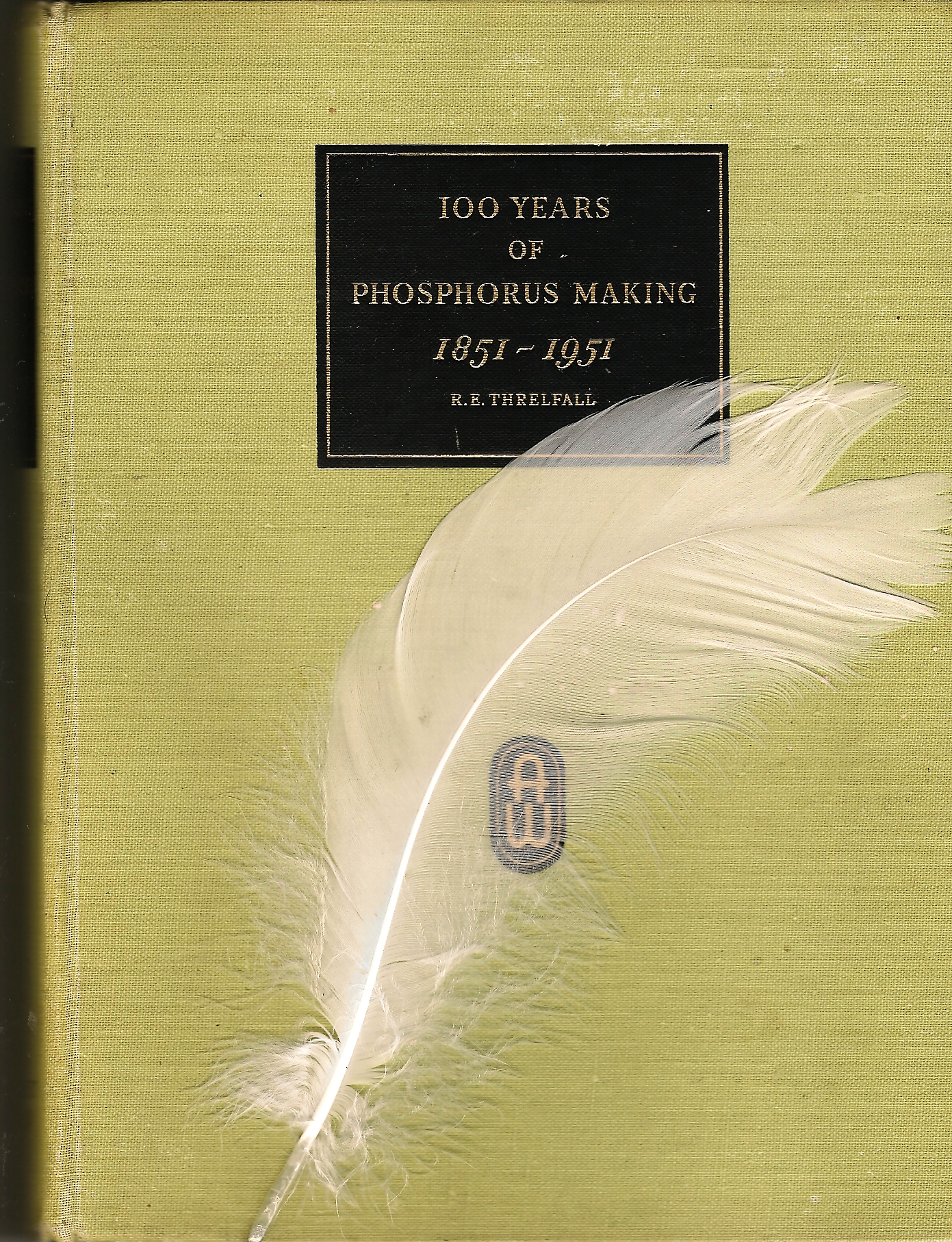
In 1951, Albright and Wilson celebrated their centenary anniversary of their official founding factory in Oldbury. A book was issued written by Richard Threlfall, which I have cited on many occasions on this website given that it reveals a number of rather embarrassing and revealing statements, though very little indeed about disposal of their toxic waste. 🙁
I have looked at how the two main families were not in any way philanthropic, but had a vested interest in moulding their communities by capitalist manufacture. This phoney social dependency made them elites, and they lived much better and longer lives than most of their workers who toiled with dangerous and toxic substances like white phosphorus. The two families descendants were fox hunting /hunting scum and were far from being poor downtrodden Quakers as the Threlfall book likes to portray. They were also ingratiated into the worlds of the judiciary, politics and health, and so could control and manipulate events to their company profitability, especially through their military supply links, where the idea that they were men of peace is shot to pieces. They also of course had many contacts through their ghastly cult and fake religion of “the society of friends”.
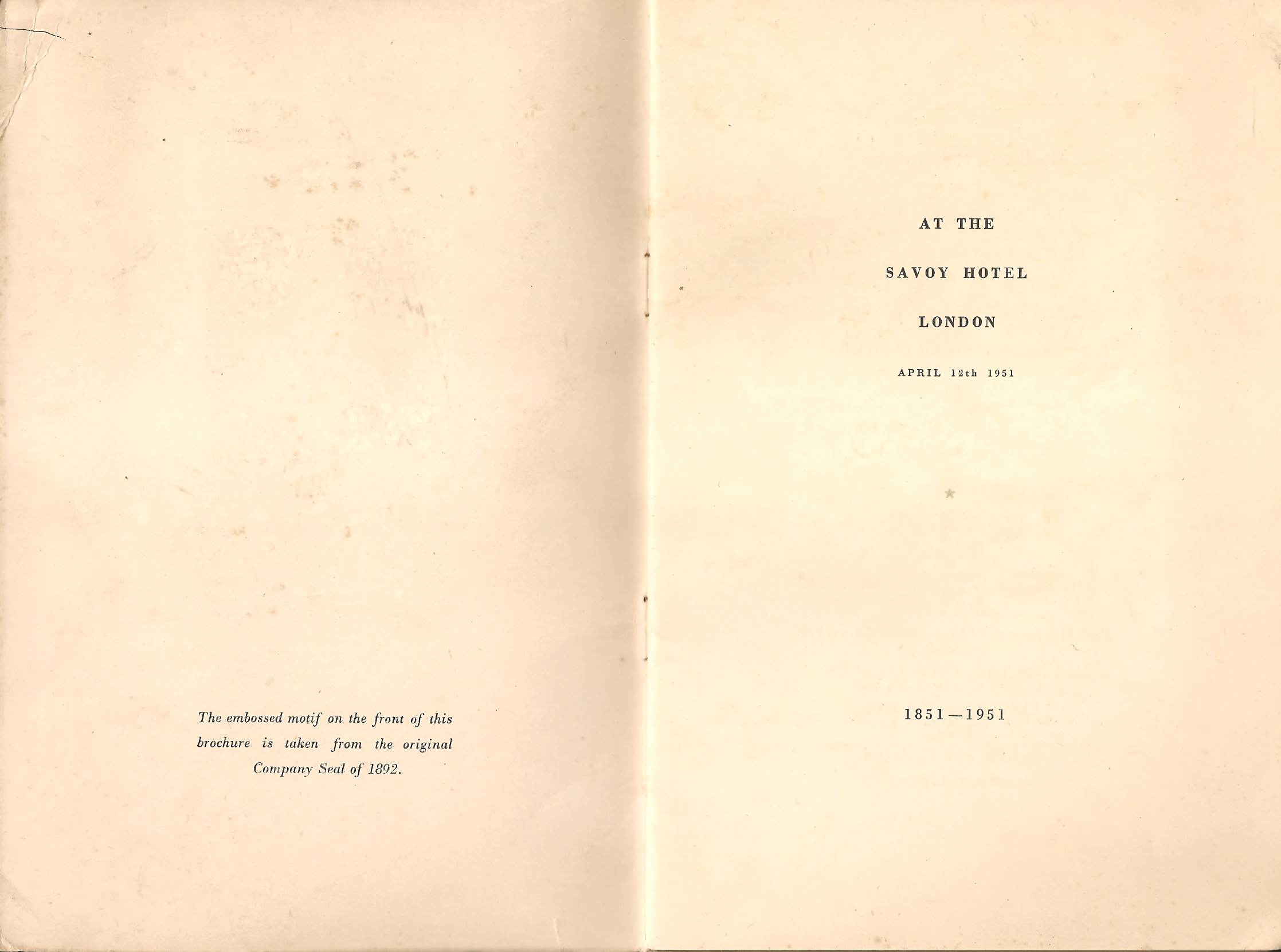
So it was perhaps fitting that in the 100 year anniversary, there was a gathering of over 400 elites at The Savoy Hotel in London, a world far removed from the squalor of their Langley factory, where the smell of cat piss as well as thick smogs blighted the area.
It is worth labouring this point as a choice of venue for this shindig. Though their head office at this time may have been situated in London, you would think that to mark the founding of the AW partnership, they may have symbolically chosen a venue in Oldbury? Obviously the area did not really mean that much to them, and why slum it in the West Midlands when the City of Westminster awaited?
The Savoy Hotel remains one of the most prestigious in the country , and attracted both celebrity and Royal guests at this time. Obviously the company hierarchy considered themselves to be worthy of such “equality”, thus making the idea of humble Quakerism a complete joke.
This event is referenced in the centennial book from page 242 onward, but I have recently acquired a copy of the programme event of this glutinous gathering, and am now serving this up for your peasantry Christmas feast perusal.
Gold and silver leaf design, inset with the naked boy symbol of the company bearing a flaming torch.
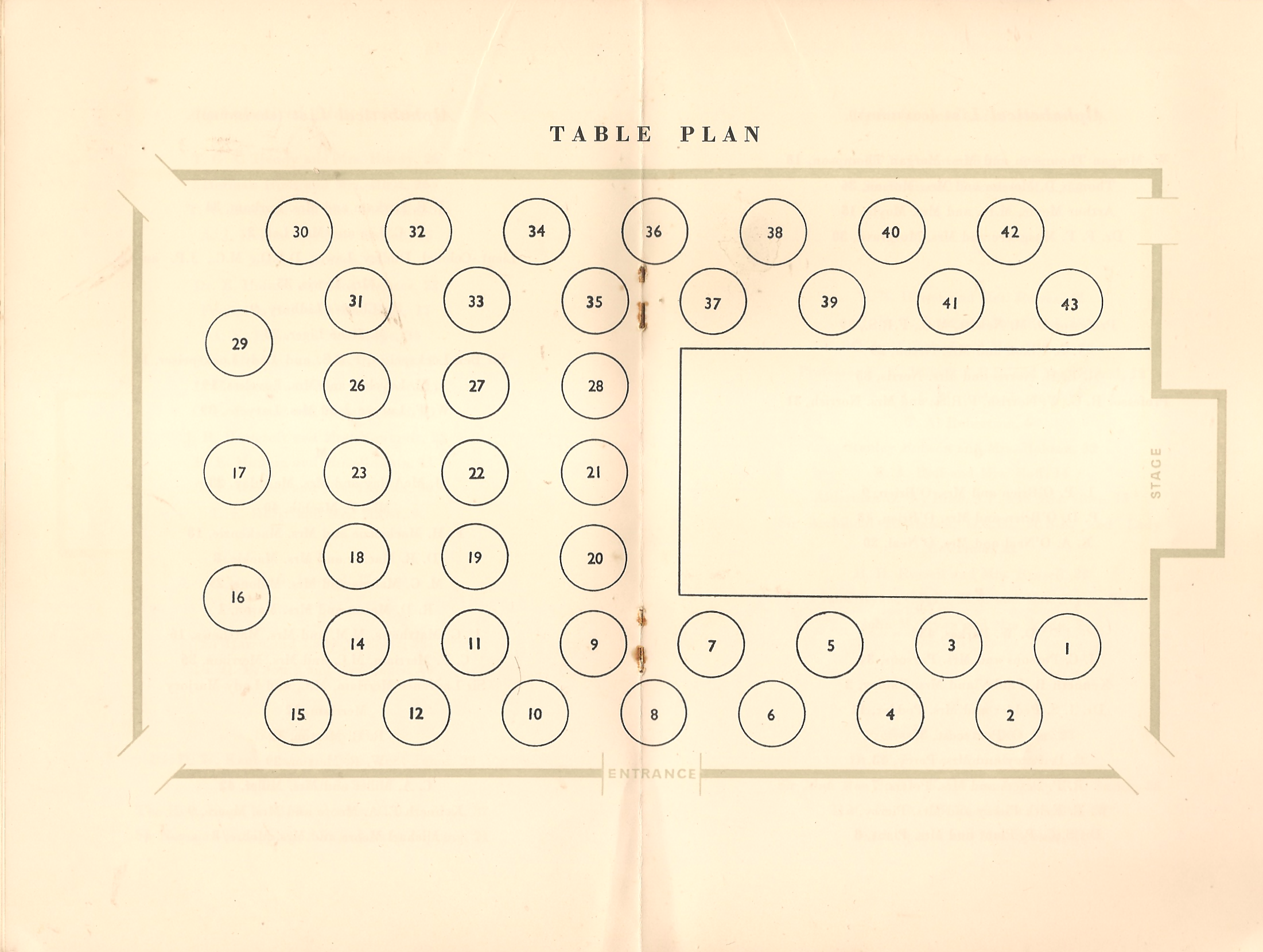
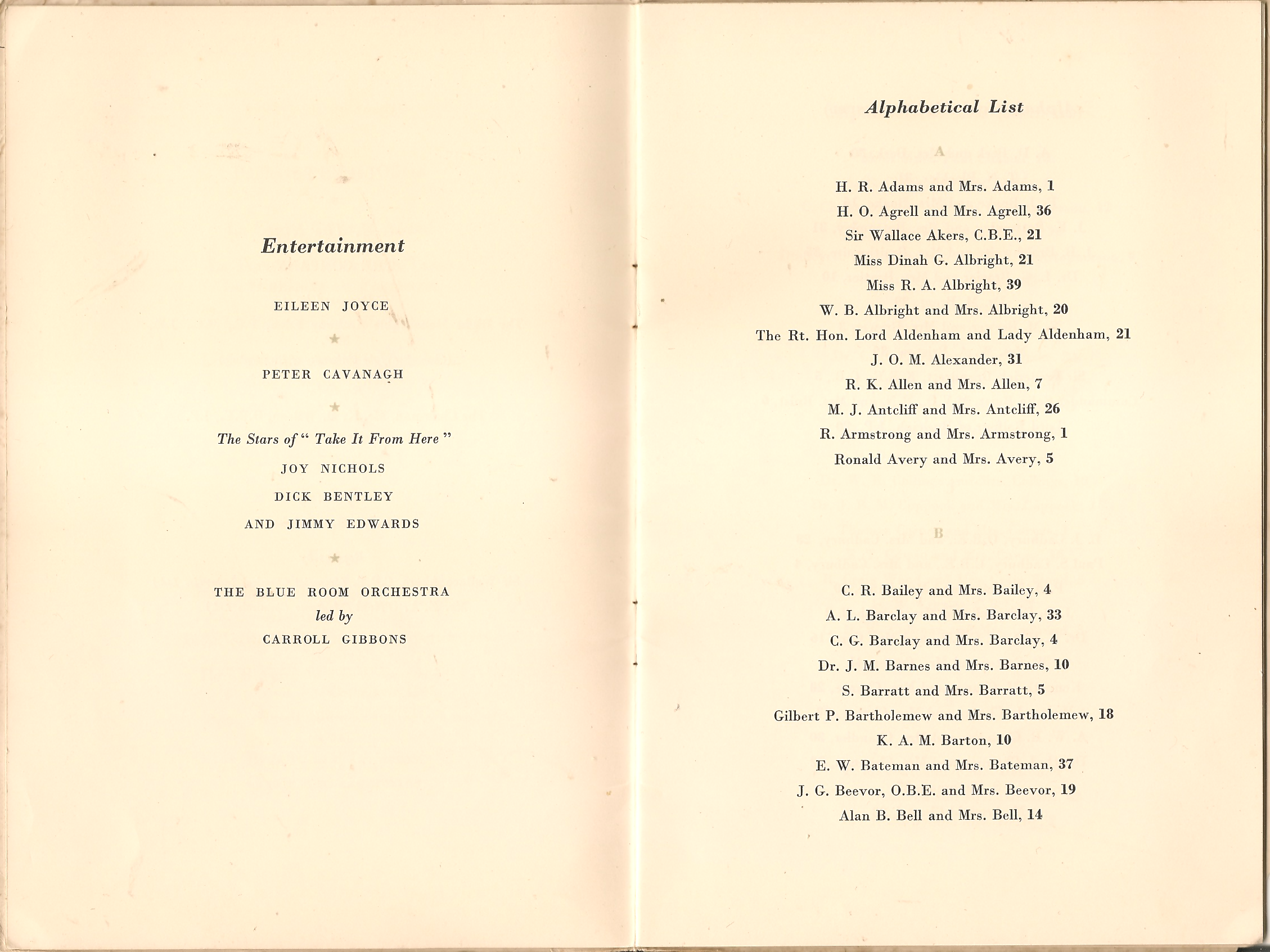
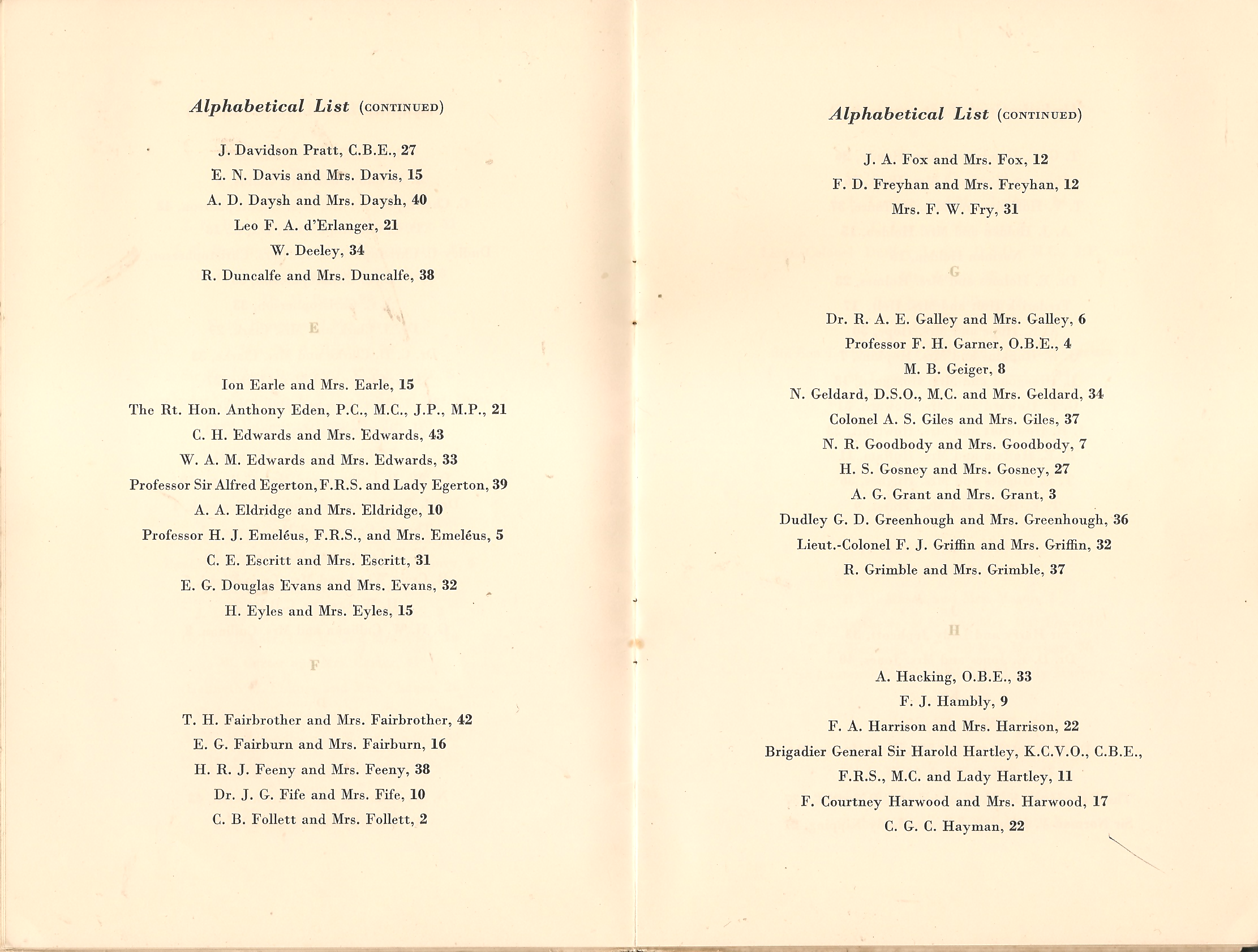
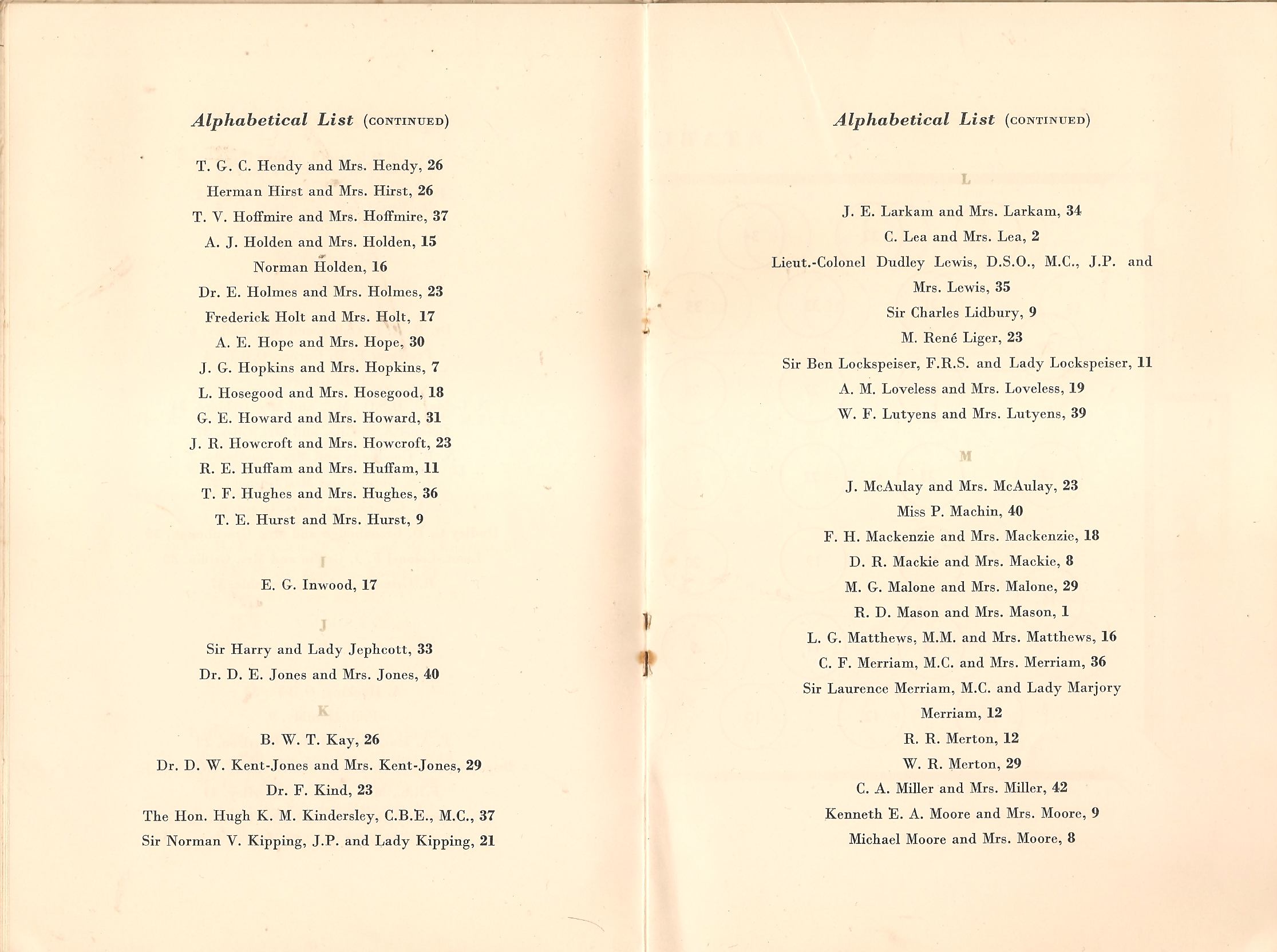
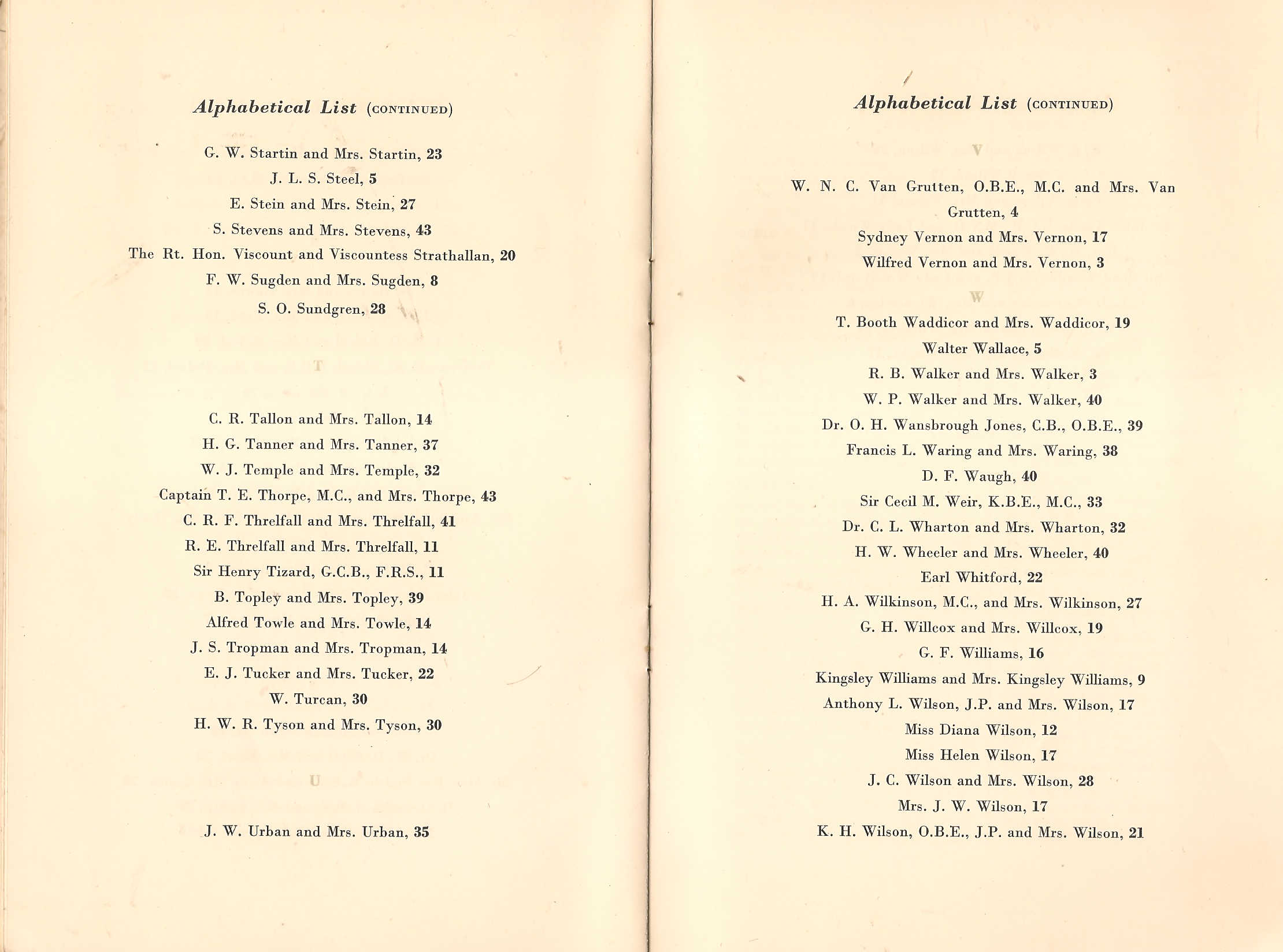
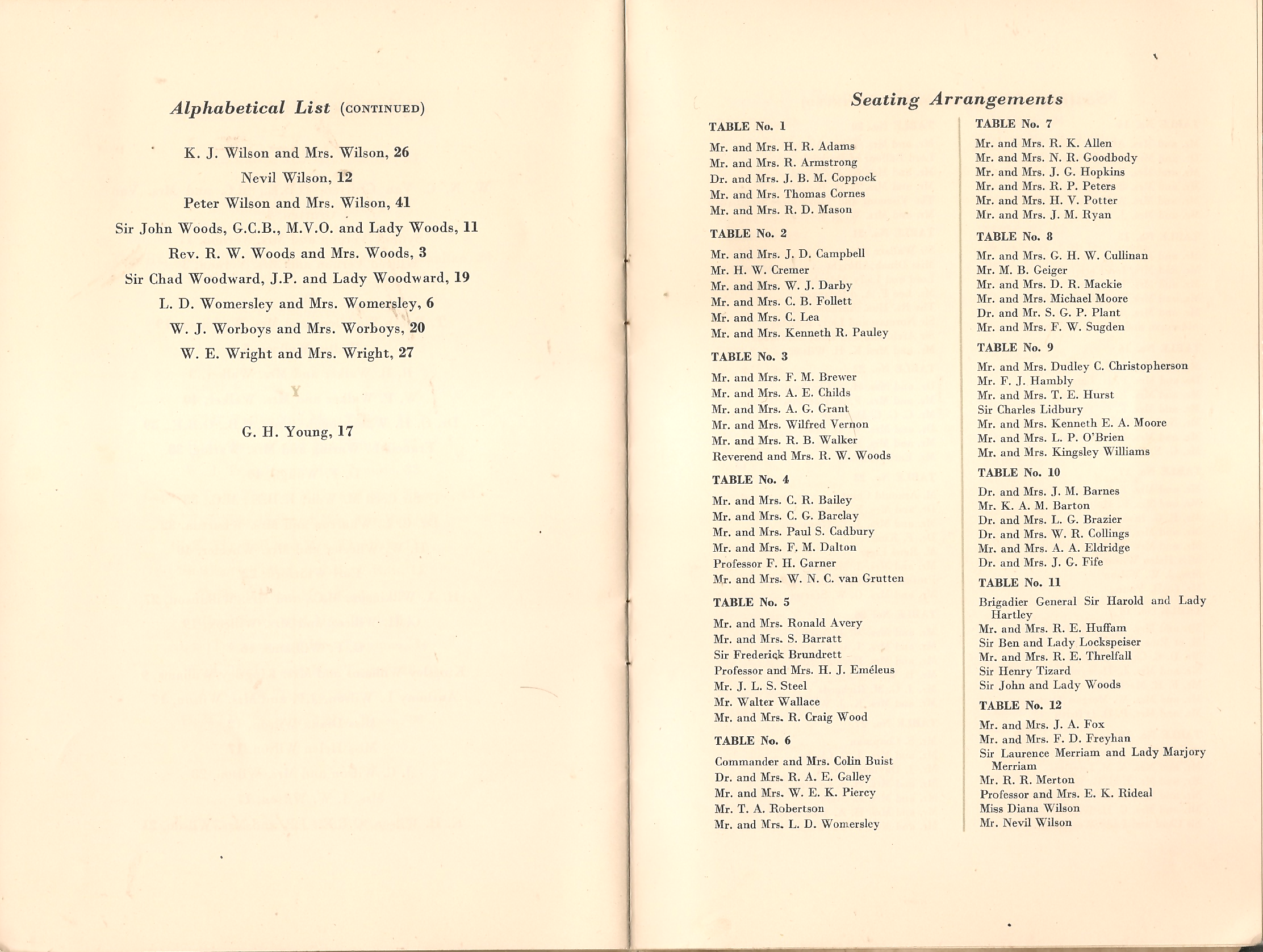
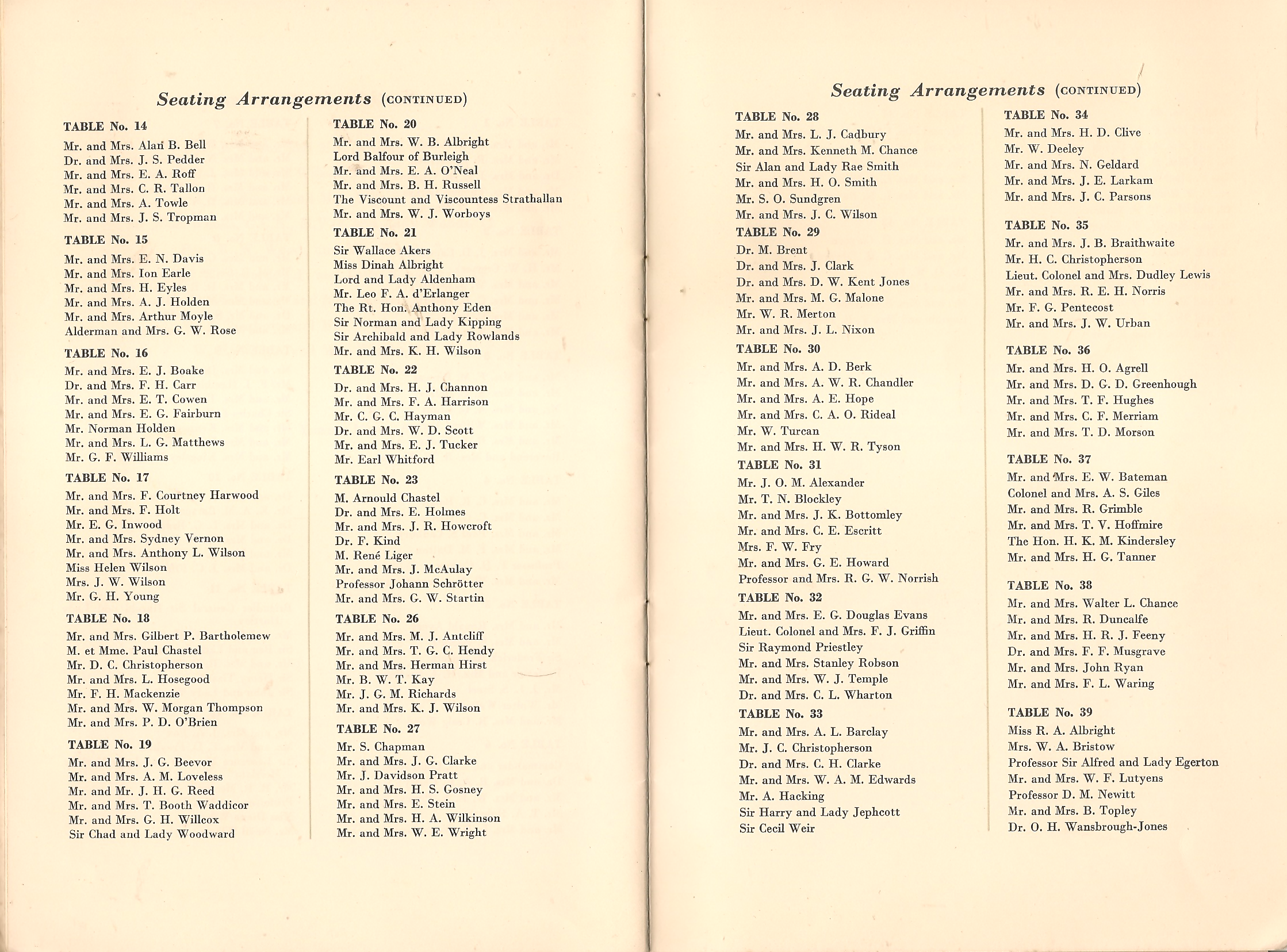
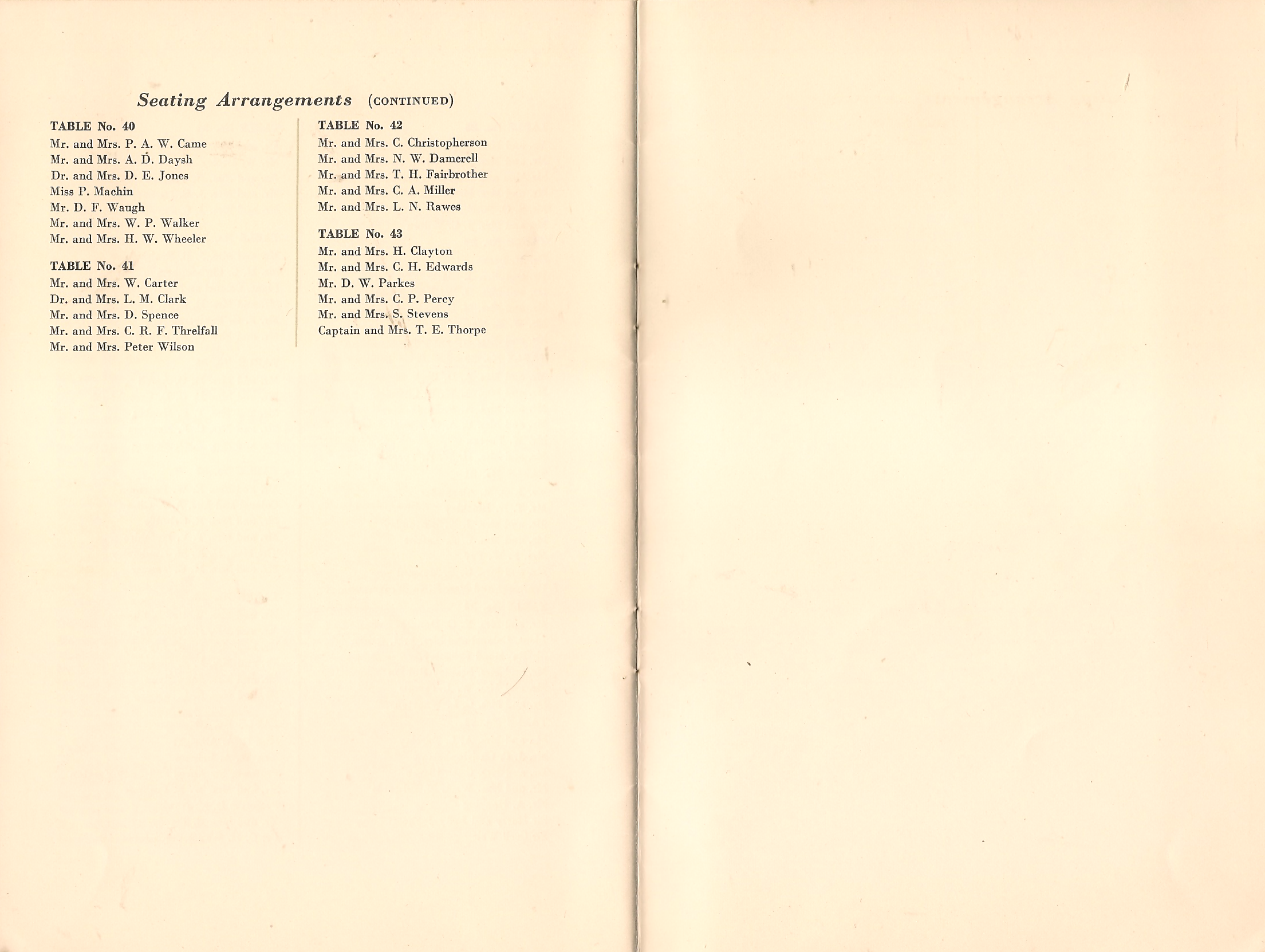
In total, 441 people are listed alphabetically by name, (a true bevy of Etonian old boy ox-bridge mafia), and also then by table arrangement. A handy plan is provided in the centre pages of the booklet, with the 43 numbered tables arranged in rows from the stage. Oddly the numbers 13, 24 and 25 are missing. Perhaps they were a little superstitious, or some people had not been able to make it, so a last minute reshuffle was arranged?
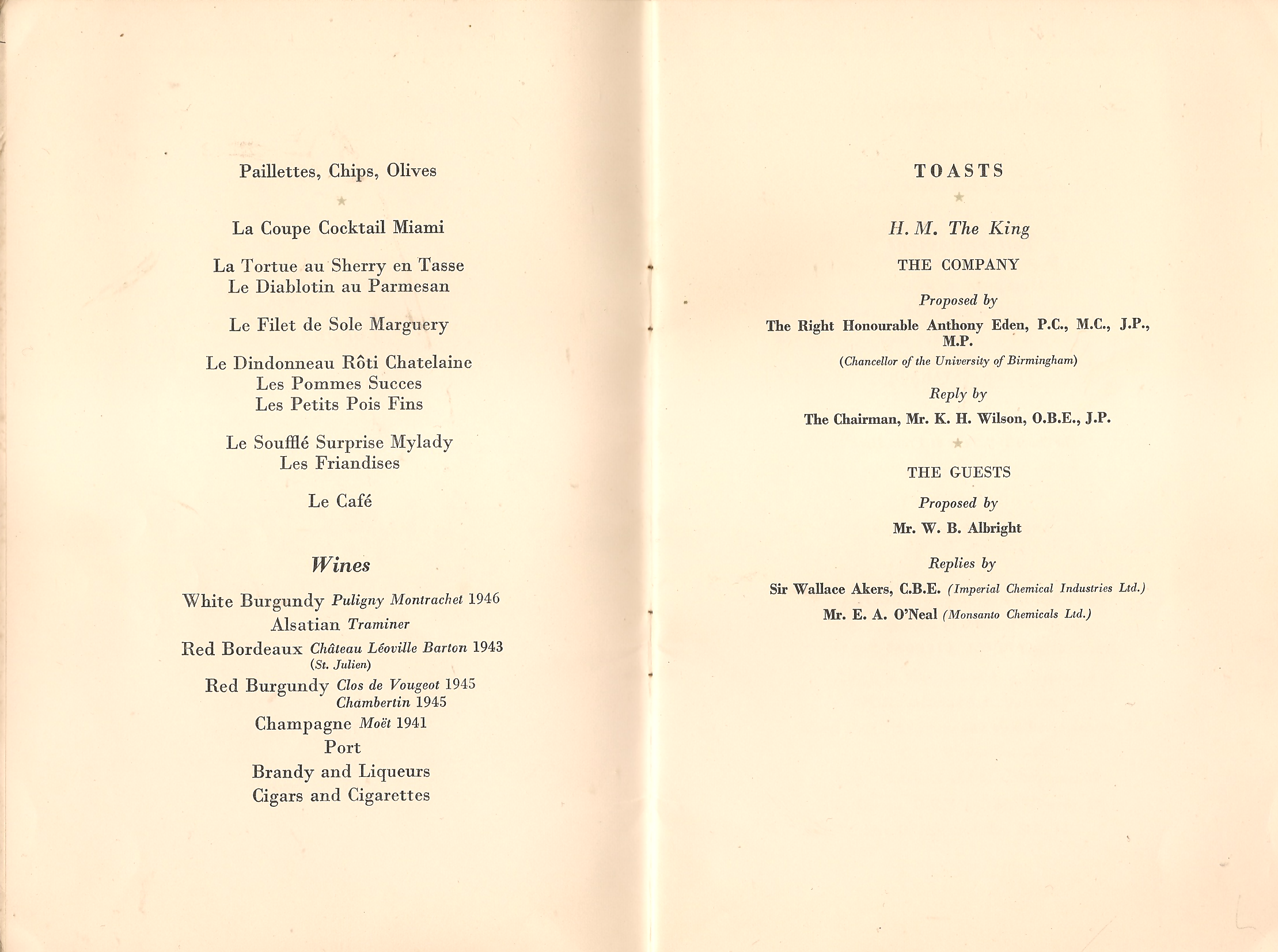
THE MENU
Of course no expense was spared in the culinary department as the pretentious French menu attests, though I’m just surprised that there was no rôti de porc on offer. Then again, that would probably have been classed as cannibalism, and we can’t have the society of friends doing that can we? 😀
Entertainment was provided by ivory tinkler Eileen Joyce. Here’s a rendition to get Listz to. I wonder if she played it that night from the stage?
and there was also “comedy” from some cheeky chappy Bobby Davro impressionist called Peter Cavanagh. Oh how they must have roared as they sipped the champers.
The phrase “you a judge a person by the company that they keep” is perhaps fitting here when applied to you can judge this company by the company that they kept at this gathering. A veritable who’s who of the then chemical industry, a collection of family members from the two vile families and their society of Friends cousins from similar, and some politicians and civil servant/military top brass that they could no doubt call on to do them special favours. I think it’s fairly safe to say that there were no BAMES on the guest list that night. 😉 Here are some I have researched.
A.
Harry R Adams, involved in managing Albright and Wilson’s food phosphate department and also AW offshoot The Antelope Company.
Sir Wallace Akers I.C.I bigwig, but also covert war agent for The British Government before this involved in the early design implications of the atomic bomb! Also instrumental in setting up the UK atomic energy authority. What a fine fellow in line with “the peace loving Quaker” background of the Albright and Wilsons. 😆
Dinah Albright, (born Geraldine) was the grand daughter of Arthur Albright, daughter of A. B Albright, niece of the grotesque fox hunter George (girls name) Albright, who was also a major donor on death in 1990 to The National Trust.
Rachel Ann Albright, grand daughter of Arthur Albright and daughter of John Albright, and sister to the pompous William Beaumont Albright.
W.B Albright and Mrs Albright. The war dodging shooter , cum home guard poser, creator of “The Oldbury smell.” Mrs Albright- Evelyn, (nee Bromley) loved wearing dead animals, but once had a mink fur coat nicked from their manor. 😆 One can imagine that a multitude of skins were worn by numerous scags that night at the Savoy.
“Lord Aldernham and Lady Aldernham” – a hereditary peer, real name Wally Gibbs. 😆 Don’t know what connection they had to the phosphorus firm, but obviously very handy to have a Lud on side.
Roger Kenneth Allen from the Quaker family who owned the business Stafford Allen, and directly related to both families by their weird incestuous inter family trees. His company would become acquired by AW in the 1960’s.
J.O.M Alexander. Another high up military character by all accounts- again a strange recurring theme for such a “peace loving” company. 😆
Maurice Antcliff Long time AWold boy and manager who left in 1935 to manage Albright and Wilson Ireland. Returned to Oldbury during the war where he was involved in liaison with Government officials concerning the production of war munitions. Also later became AW’s personnel manager.
B
Barclay x4 Presumably of the Quaker banking clan
Sidney Barratt Former assistant Director of research and chairman of the company, and also in the works 8th Worcestershire home guard as “captain”, I have his personal map of the area. LOL .
Kim. A Barton Former AW board member who became involved with the Midland Silicones company offshoot.
Edmond Johnson Boake Of the A&W later acquired company Boake Roberts, who made phosphate plasticisers and also fragrances.
James Bottomley Another Albright and Wilson board member at the time of this event. Also involved at one point with the offshoot London company Thomas Tyrer
Sir Frederick Brundrett Instrumental in getting jobs for the boys in WW2- “solider” scientists. After the war he would become chief scientific officer at The Ministry of Defence.
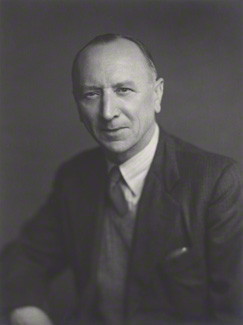
Certainly the most notable guest at this event. He was chancellor at The University of Birmingham- the long time academic rat nest of Albright and Wilson.
Conservative MP for Warwick and Leamington and at this time in opposition to the Labour Government. Later in the year the Conservatives would win the election where he would become Foreign secretary. Albright and Wilson obviously wanted an on tap political figure, and no doubt he served this purpose.
He would become Prime Minister in 1955 and would be known as one of the weakest to ever hold office on account of The Suez crisis which led to a national humiliation.
Charles Edwards Of the Christopherson Antelope company and at this time Manager of the General chemicals department.
An academic with a fake military seniority. “Later appointed Controller of Chemical Warfare Department, with the rank of Brigadier-General.” Another uneasy connection with the so called Quaker “peace lovers”.
J
Sir Harry Jephcott Big pharma Guru in the form of Glaxo laboratories- obviously well placed for the Albright and Wilson company. Also involved with Ministry of Supply during WW2.
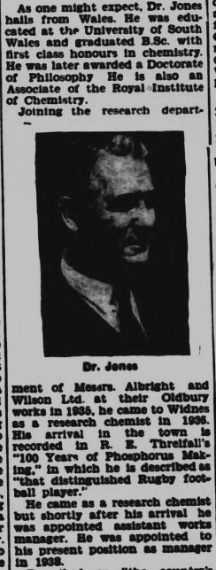
Dr David E Jones Long time works manager at Albright and Wilson’s Widnes factory.
K
Hugh Kindersley Former D day veteran , businessman, and at this point in time, Director of The Bank of England.
Sir Norman Kipping seconded to government service; he was placed in control of the Regional Division of the Ministry of Production until the end of the war. Director General of the Federation of British Industries 1946- 65. Also apparently attended the clandestine cult of the Bilderbergs in 1959 apparently.
Sir Ben Lockspeiser “During the Second World War he was promoted and worked on secret projects for the Admiralty” Say no more, right up the Albright and Wilson bows then.
Alfred H Loveless Albright and Wilson works engineer and part time British agent, who inspected the Nazi phosphorus factories for the Ministry of Supply, and thus gained insight into this when commercially updating the Albright and Wilson post war machine. The M in his name on this programme is a misprint.
M
Ron D. Mason A research chemist at Boake Roberts. Also became managing direct0r of the company formed by Albright and Wilson after acquisition Bush,Boake Allen.
Lawrence Merriam. Another soldier and later businessman.
Thomas Morson Of a pharmaceutical manufacturing family business.
Forrest Musgrave Managing director of the stinking Anglamol Oldbury Smell fame.
N
Professor D.M Newitt An Albright and Wilson board member
Academic and awarded the Nobel prize for chemistry in 1967.
P
K.R Pauley A manager and on the board at The Bristol Mineral and Land Company, another Albright and Wilson acquisition offshoot.
Dr. John Pedder a former scientist at Oldbury and later Oldbury Works manager.
Frederick G Pentecost Chairman of company Boake Roberts a plasticiser business acquired by Albright and Wilson in 1959. Albright and Wilson sold large amounts of phosphorous oxychloride to this company for the process. Interesting that he was on the guestlist here 8 years earlier.
W.E Keith Piercy An executive board member of the company and also a member of the A&W Home Guard.
Sir Raymond Priestley Another former military man and geologist/explorer. Perhaps on the Albright and Wilson guest list as to his then links with their friends at The University of Birmingham where he was vice chancellor.
E. Avery Roth A technical chemist at Albright and Wilson’s associated Thomas Tyrer works.
Sir Archibald RowlandsYet another ex military then pen pusher at The Ministry of Aircraft production during WW2. Then later Albright and Wilson’s favourites- the Ministry of Supply.
S
Johann Schrötter
Grandson of the same named red phosphorus producer of Vienna, whom Arthur Albright conspired with to make a match business.
Internationalist meddling do-gooder and Liberal politician, First secretary of the League of Nations (league of imperialists) – at home with the crowd at A&W no doubt. Snuffed it in this same year.
T
T.E Thorpe possibly a scientist who published papers on phosphorus compounds or a relative.
Richard Evelyn Threlfall
Son of Sir Richard Threlfall and board member of A&W. Wrote the book “100 years of phosphorus making” of the company history up to this year.
Another scientist /clandestine military man involved amongst other things in the development of radar. At this point in time he was chief scientific advisor to The Ministry of Defence.
“One of the most controversial meetings Tizard had to attend in his capacity as chair of the Defence Research Policy Committee would only emerge many years later with the declassification of CIA documents, namely a meeting on 1 June 1951 at the Ritz-Carlton Hotel in Montreal, Quebec, Canada, between Tizard, Omond Solandt (chairman of Defence Research and Development Canada) and representatives of the CIA, to discuss “brainwashing“.[7 “
Fitted in very well with this cult then.
Brian Topley
Researcher and director of the company who would become most notably associated with the production of the useless AW bombs. His formula of benzene/phosphorus would of course be manufactured in millions of half pint milk bottles, which are still being dug up to this day, as dangerous as they were back then.
William Turcan
Executive officer at Thomas Tyrer- AW associate company
V
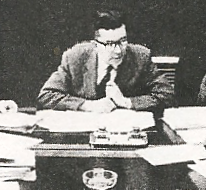
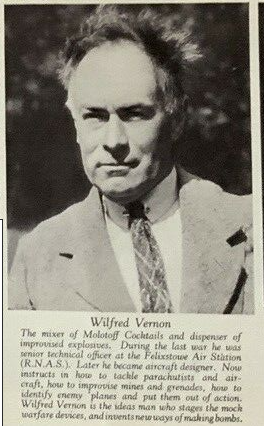
Wilfred Vernon If I were a betting man, I would say that this is him with his mad as a box of frogs look. Involved with The Home Guard training school in Osterley park near London – this picture appeared in The Picture Post dated 21st September 1940. He appears to be involved with training in the use of Molotov cocktails and the like, so right up the AW bombs street.
“bomb maker”
W
R. Bruce Walker From the A&W Canadian Buckingham factory.
Walter Wallace A former assistant to Threlfall in A&W’s research laboratory in Oldbury. Also prominently involved in the Niagara Falls project where he had retired in 1949.
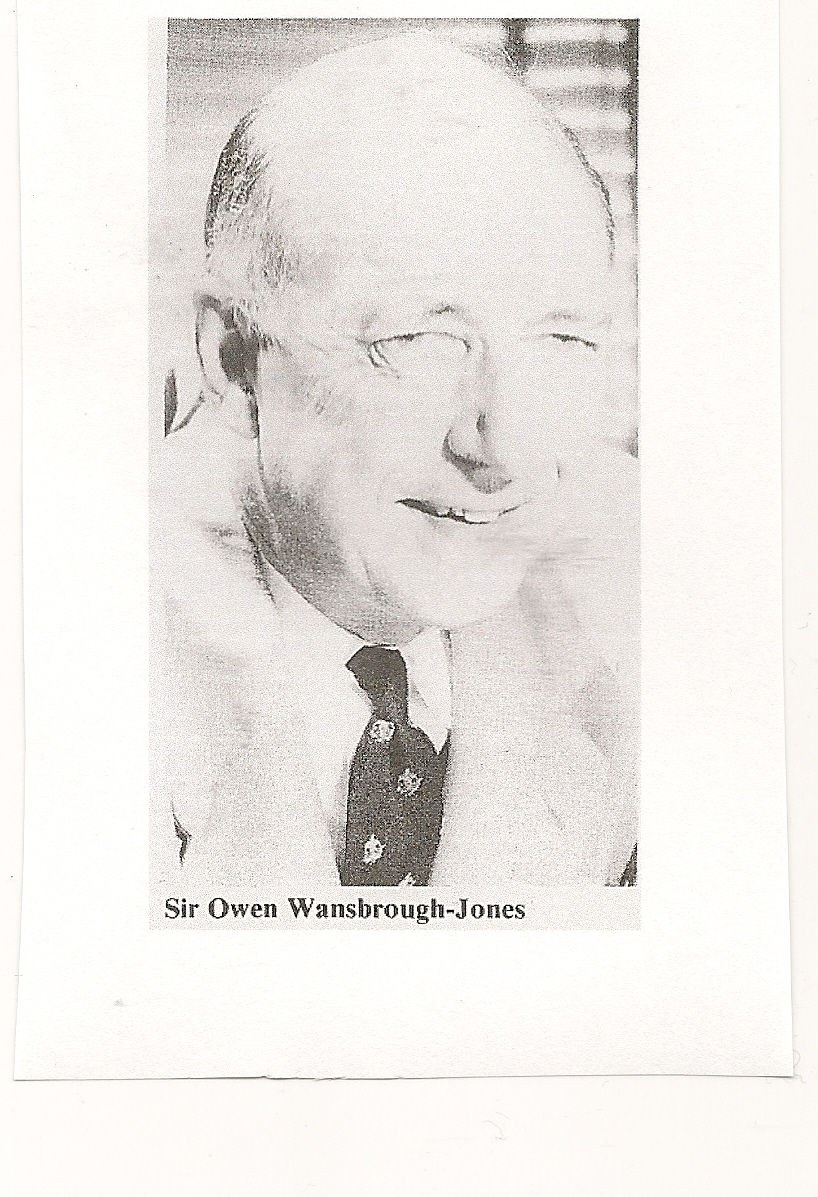
Owen Wansbrough-Jones
Another sinister civil servant/pretend military figure who joined Albright and Wilson post war.
In 1940 was commissioned into the royal engineers, rising to the rank of brigadier in 1945. In the British army he specialised in chemical and biological warfare and also became the “director of Special weapons and vehicles” in the Ministry of Supply in 1946.
After a series of advisory and administrative posts, he was appointed chief scientist to the Ministry of supply in 1953, until he retired in 1959. He was knighted in 1955.
His next job, a seamless transition in 1959 was as technical advisor to Albright and Wilson- a military supplier of phosphorus both during and after the war. He was later to become executive vice- chairman and eventually chairman of the military supplier.
IT IS VERY INTERESTING TO NOTE THAT HE WAS PRESENT AT THIS EVENT AND WELL ACQUAINTED WITH ALBRIGHT AND WILSON BEFORE HE JOINED THEM, AND WHEN HE WAS STILL IN HIS ROLE AT THE MINISTRY OF SUPPLY. THIS ONLY SERVES AS FURTHER PROOF OF HOW THIS COMPANY WERE TIED TO MILITARY AND WARFARE ACTIVITIES.
Cecil Weir Of the leather and hide merchants Schrader, Mitchell and Weir. Another civil servant involved amongst other things with The Ministry of Supply.
Earl Whitford Of the Niagara Falls Oldbury Electrical company, and future president of this.
A whole batch of Wilson’s – descendants of the bearded wonder John Edward.
Of note
John Christopher Wilson Secretary of the company at this time
Kenneth Henry Wilson
Kenneth Wilson was a long time chairman of this company, and when the company history was published he sent out signed notes to certain individuals with a copy of the Threlfall book. Also made the speech at this dinner, see below.
Y
G.H.Young A board member of Albright and Wilson offshoot The Bristol Mineral and Land company
SEATING ARRANGEMENT
I’m sure they had much to talk about, like the price of phosphorus. 😆
The toast and speeches
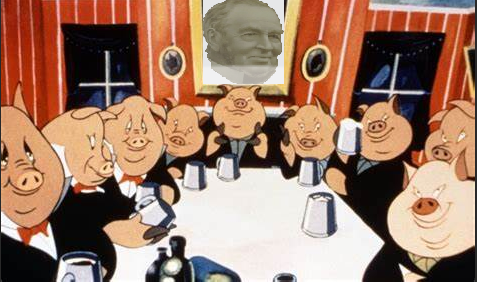
Kenneth Wilson’s speech is given in the centenary book in its entirety between pages 243-251, which I have no intention of reproducing here. It is as the book reads, a sycophantic eye dabbing pile of bollocks, perfectly attuned to that of Napoleon from Animal Farm.
Perhaps the most telling quote from this man came towards the end in respect of their workforce
“They all pulled their weight and set us an example of service and love of their masters and the firm, if I may use this term.”
Well of course they did.
“We eat for you”.
There were also cigars and cigarettes on offer on the menu, and one wonders if the gentlemen later had an excursion to Great Ormond Street to continue their “charitable” work after some homoerotic secret society meeting down the lodge.
But fear not the excluded “servants” of Albright and Wilson, for according to page 251 of the Threlfall volume, a works do was organised just 11 days later for apparently over 300 members of the company at The Grand Hotel in Birmingham. I would suggest that perhaps they had just scooped up all the leftovers from the Savoy and saved them for the doggy bag scutters at Oldbury. More speeches were made by the usual suspects of the company founder piggy families.
With such a collection of the greatest chemical minds in the country gathered at the first banquet, as well as politicians and military men of repute, one wonders why they could not solve the issues of Albright and Wilson’s dirty waste stream, smells and the issues of phosphorus and its dangerous breakdown products which came out of the factory at Langley. Of course, they all conspired to dump the waste out of sight and out of mind in a former brick works pit in Oldbury as cheaply as possible, but as far away from where they lived so it didn’t matter.
5th July of 1950 Birmingham Gazette.
“FRESH AIR IS DENIED IN BROADWELL AND CENTRAL WARDS”
philanthro-capitalist scum
Posted inUncategorized|Comments Off on Albright and Wilson’s 100 year gluttony event
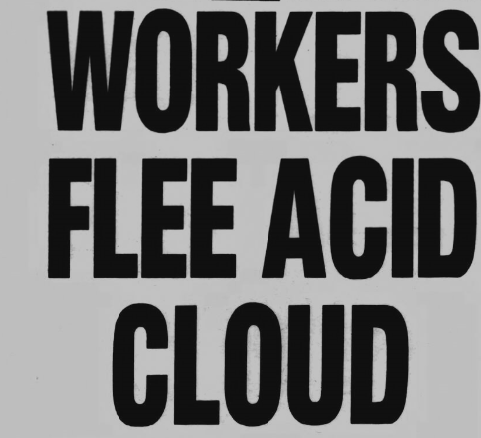
1990 appears to have been an annus horribilis for the management of Albright and Wilson- the dirty Oldbury chemical factory based polluter. Not only did they have problems at Portishead with a major fire involving white phosphorus, but closer to home their wrath engulfed Oldbury pouring scrutiny on the integrity of the useless works manager “Dr” Peter Bloore.
The 13th February Sandwell Evening Mail reported on the scene, as an orange cloud engulfed the town.
It is difficult to see how Nitric and Sulphuric acid could be “mixed”- I mean aren’t these people supposed to be “scientists”? 😆
Seven years later, the newly created Environment Agency inspected the factory, though this incident appears to have escaped their predecessors attention at the Walsall council run Hazardous Waste Unit; how remiss when one considers that the safety systems supposedly in place failed miserably, and there was an uncontrolled off site release of gas.
Rarely for the A&W rimmers at WMFS, one brave sole actually states the danger and doesn’t try to patronise the local residents, but reverts to type on praising the A&W own fire service. 🙄
“It could have been a lot worse- this sort of acid can do serious damage to your lungs if you breathe it in.”
Obviously someone did nothing right when they mixed two very dangerous acids together! The policeman quoted however is another prime example of how this protected company could get away with scrutiny. It wasn’t “a minor incident” if this company had failed to contain the cloud within their own factory, and another chemical company had had to be evacuated! Such claims as “it was believed the gas cloud diluted very quickly” is textbook of the liar Bloore, and unfortunately his lies never appeared to be challenged by anyone in authority, or even a weak press asking hard questions as to why these incidents at this plant kept occurring time and time again in very quick succession under the “management” of the same man?
I don’t think I’ve ever seen an apology where Bloore actually stated “I’m sorry to the community , we got it wrong” or “It was all our fault” .
Always and forever the list of pathetic excuses amount to read as though it was circumstances beyond the control of management, or the attempt to play down the risk. Perhaps this is what linking the reporting of environmental incidents in a company to paid bonuses for managers for lack of incidents does, (as the 1997 EA report stated had been happening at A&W) .
Posted inUncategorized|Comments Off on Albright’s toxic archives #28 A cloud over Oldbury #1
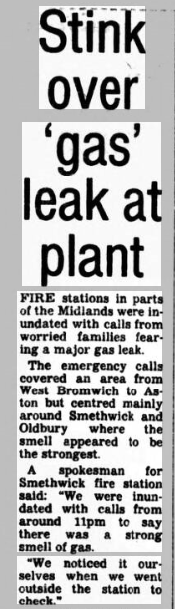
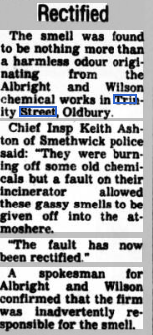
We all know that the jaw rotters of POBox 80 had a long and terrible odour issue, their trumps resembling the infamous pussy bouquet aka “The Oldbury smell”. But events in February and March 1990 appear to have evoked the spirit of bagpuss as reports from the 12th February 1990 Sandwell Evening Mail attest.
It is clear that this was a nuisance for local residents who had made calls to the emergency services about the stench of gas arising from the Trinity Street Albright and Wilson works.
Apparently, and as they always appear to do, the plod from the area play down the incident by stating that their mates down the road were just having a bonfire with some chemicals. 🙄 That the firm was “inadvertently” responsible for the smell is a priceless PR classic worthy of the many from the A&W archive of terrible environmental crimes.
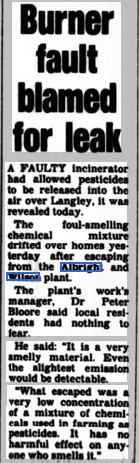
But What’s up Doc? The following month we appear to get exactly the same occurrence as revealed in 28th March 1990 Sandwell Evening Mail. Once again the leak is blamed on a piece of equipment, and not the managerial methods and decision process for averting a statutory environmental nuisance.
It is now revealed that the chemicals being burned were pesticides! We now get the liar “Dr” Bloore in full head spinning mode, with the usual message that there was nothing to fear. 😆 I think I would have preferred to have a safety data sheet with the name of the chemical(s) released off site to make that determination for myself.
Unfortunately, this is the exact same bullshit that Bloore and others came out with when confronted with the substances at Rattlechain lagoon.
“It’s the stuff used in toothpaste”
Their “everyday chemicals” mantra is employed here again where they mention farms- which are not located in built up residential areas.
With so much chemical apparatus at their disposal, it’s a wonder they never found a suitable man sized bung to plug those troublesome orifices emanating from the toxic Oldbury bunker.
Posted inUncategorized|Comments Off on Albright’s toxic archives #27- Bloore’s bad gas
This article from 27 June 1988 from The Sandwell Evening Mail reveals more troubling information about phosphine gas escaping. This was put down to “a pressure surge in a reactor” which allowed the gas to escape, instantly catching fire when exposed to air.
There are some observations to be made about this. This is the same P1 production plant that resulted in the 2009 uncontrolled release of phosphine gas which led to a far more serious incident. There is absolutely no mention at all of this 1988 incident in the official HSE report and investigation where Rhodia’s cut and shut “rodder” assembly failed, as explained below.
One wonders on how many occasions before this event that there had been “pressure surges” in this apparatus, and why management had not acted upon it, or even if they had covered them up when their bonuses were directly linked to environmental and safety performances? 😕
Mention of the exact incident which appears to have occurred below is even mentioned in the 1980 planning application Ref DC/10316 for the P1 plant.
“A water seal tank , 0.6m3 capacity , serves both the convertor and the reactor to prevent overpressurisation of the equipment. This occurrence should be rare. If it does happen, phosphine would be emitted at this point where it would be expected to catch fire.”
I have looked at the historic production of phosphine and the installation of this 1st plant HERE.
Thirdly this is one of MANY incidents under the stewardship of “Dr”Peter Bloore, and as will be revealed in several future posts, his management during his time as works manager at Trinity Street was an absolute catalogue of environmental disasters and health and safety shams.
Below, from evidence presented by Rhodia to the HSE regards the Albright and Wilson built phosphine no 1 plant fire 21 years later. YOU BLOODY LIAR BLOORE! But just a reflection of the company he worked for.
Posted inUncategorized|Comments Off on Albright’s toxic archives #26 Phosphine under pressure
Much has been made and still continues to be about the firefighting practice that the Trinity Street factory is prepared for with their own “fire service”, and also their alleged collaboration with the full time professionals, yet when it has really hit the fan, such as the uncontrolled release and fire involving phosphine gas, this was revealed to be a complete smokescreen, and a very worrying trend for those living in the shadow of the Trinity Street Top Tier COMAH site.
What a load of bullocks!
Historically much of the time, it appears that this volunteer works brigade ponced about in emergency worker wannabe attire having competitions with other works brigades in wacky races on sports fields. They were also not averse to deliberately starting fires using toxic white phosphorus, such as this picture from Albright World demonstrated when they went to Rattlechain lagoon for an experiment.
Controlled conditions outside? And against the conditions of the waste management licence! And where did the contaminated waste and raked ground from this go I wonder?
This Bonfire night post offering from The Sandwell Evening Mail from 14thFebruary1986 shows another total farcical situation involving the absent Albright part timers, who were not on site at the time of a real fire at their COMAH Top Tier chemical factory, which at this point in time still had chlorine and phosphorus delivered by train into the works. They were instead watching a fire fighting video at Oldbury fire station. 😆 You really could not make this shit up.
“Coincidence”. They only had two jobs.
Posted inUncategorized|Comments Off on Albright’s toxic archives #25 – Oldbury’s Firemen Shams- not Albright on the night.
We live in very dangerous times, and the state police now appear to be everywhere watching our every move.
A new piece of legislation, “The Covert Human Intelligence Sources Bill” has gained large condemnation from civil rights campaigners and activists involved in campaigning against things which Governments such as the one that we now unfortunately have support or want to push through without due scrutiny, debate or legal sanction. The arguments and background are put forward in this Guardian article.
“Covert intelligence can be authorised to “prevent disorder” and to promote “the interests of economic wellbeing of the UK” as well as to protect national security.”
But this list does not just apply to MI5 and the security services or even just plod. It encompasses a wide range of authorities and quangos, who would if this Bill becomes law, be given unprecedented powers to spy and acquire information from Joe public. Quite why some of these are on the list is baffling, as are the powers that they would be able to have. This BBC piece lists the agencies, and one in particular I find very intriguing.
I am baffled as to what criminal actions that the EA would be sanctioned to undertake. Perhaps as the biggest polluter to the environment in the country, this law is to avoid them being criminally liable for such, or perhaps attempting to make them immune from civil litigation regards their disastrous flood alleviation scheme failures?
Are the EA operatives going to be encouraged to sleep with waste tippers or have affairs with their wives in order to get to the nitty gritty as to what they are hiding in their dirty drawers?
Or are these soldiers of the state really being seconded to spy on the public, those who object to planning applications, those who defend ancient woodlands from the scum of HS2 Limited, and of course those who ask questions about “what’s in my backyard” , that they already appear to have obfuscated material from. Can the EA now just lie that they do not hold any Environmental Information , even when they do in FOI requests? The use of such undercover agents has been used before to gain information about environmental protest groups, and animal rights activists, as this excellent expose reveals, to devastating consequences for those who trusted these agents of the state. The Metropolitan Police unleashed sexual predators who manipulated and coercively controlled several women and had to pay them compensation. .
Could the same tactics now be made lawful, and for a range of other agencies like the EA? And how far for Queen Lizzy and country are they sanctioned to go to protect esoteric civil service information? Murder? 🙁
Of course conversely, it could be the case that industrial plants have been placed inside the EA or even criminals to water down environmental protection. You would certainly think so from the things that I have seen and heard about. 😉 Send in AC-12 to root em out.
So to any environmental campaigners out there, this Halloween or going forward in these dystopian times, watch out in case the EA’s stealthy assassins are waiting to get you with pointy tits underneath the high vis, or hiding a sharp dagger or cutting tool concealed in podgy chest waders……I’m sure they are very well trained 😆
Posted inUncategorized|Comments Off on The Environment Agency- Licensed to spill, but also to Kill?
The document below is a must read for anyone who lives next to or had their homes built on a historic landfill site. Unfortunately, what you will read in the file has probably already been deleted by the powers that be before it was published. Special thanks must go to Dan for sending me this, and it is an interesting read.
The Excel file shows information that The Environment Agency claim to hold on these blighted sites, yet it is clear that the information is very limited and in some instances I have observed , not even correct. It is the omissions however that I find most sinister, as this information is presumably used to prepare the agencies response to planning applications where they are a statutory consultee, but the information about the sites is wafer thin- most notably on the types and quantities of waste that were deposited.
The following is a rough guide to the list, and I do not profess to know what all of it means, as it appears to have been compiled esoterically to keep it that way.
The rows and cells list the waste sites; there are thousands of them in England and Wales listed.
I have no idea what “srsname” and “srs dimension” mean in cells A and B. The same nonsensical numbers are contained in columns C and D for “lower corner” and “upper corner”. Why this guff is there I do not know, but it is irrelevant to any of the sites themselves. Thus from the start, the list is largely illegible and designed to be off-putting.
Cells E and F also appear to be an unknown code, and G what appears to be an Environment Agency reference number for the site. Only at column H do we get something decipherable in the actual site name, though as can be seen, the detail to anyone not knowing where this refers to would be equally unintelligible.
Column I contains some more location detail, though most of these in the file are blank. No postcodes are contained , making it difficult to identify the site easily.
Column J is Environment Agency Waste management licence Reference? K registration number? L Waste Management catalogue reference? M bgs number- not a clue. N is the first real important clue as it reveals the name of the site licence number. Many of the West Midlands County Council SL numbers are contained here, and this has helped me find several that I was unaware of, which I am adding to my DOOMWATCH list. There are also the renumbered West Midland hazardous waste unit numbers, and the EA renumbered permits. Many however are inexplicably missing, as will be demonstrated further on in this post.
N reveals the licence holder, a company or a person, but again, may of these are blank, and the EA DO hold this basic information , yet why is it omitted here? Could it be that liability for “the polluter pays” has been removed because of cases such as those in Walsall? P gives more detail as to the licence holder’s address, though again, much of these details are blank.
Q gives the site operator name, and again the blanks are noted. R a space for more information about these.
S is the ordnance survey prefix, T the Easting reading, U the Northing reading. V is the Environment Agency regional area, for example MI appears to indicate Midlands. W is the EA area within their regional operation.
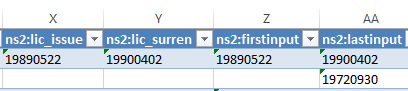
Column X is an important one as it indicates the date on which the site licence was legally issued. In the example above, this was 5th May 1989. Y indicates when the licence was legally surrendered, in the case above 4th February 1999. Column Z indicates the date when waste was first inputted into the site, and AA the last waste dumped there before licence surrender.
The next set of information relates to waste types that were dumped on site. This is of course the most important information, but one can see that it is largely missing, and does not give the detail needed for people to be able to find out what types of chemicals were deposited. AB stands for inert waste. B Industrial waste, C household waste, D “special waste”, and AG liquid sludge. The classification of what these categories mean has changed over time just to add more difficulty in knowing exactly what was dumped there.
AH perhaps stands for “Waste unknown” ? AH I would guess relates to gas control measures having been put in place, usually a condition of licence surrender if methane or carbon dioxide is being evolved which may take the form of a “gas vent barrier”. AJ I believe is leachate control measures, if a site is oozing out nasty liquids, as was the case with the Leigh Environmental company fiasco in Walsall. AK obviously relates to “exemption” , though I do not know what this relates to in context with site licensing. AL a licensed site? AM No licence required.
I do not know what “buff point” refers to at AN, and A0 and AP appear to give the shape in size of the site, though the units are missing, and could well have changed over time, of part of the site was transferred, as was the case at Rattlechain, before the licence was issued. AQ the same number as at the start of the list and AR another mystery.
Between AS and DM, a string of incomprehensible numbers appear, and I have no idea what these are.
EXAMPLES.
To demonstrate the abysmal gaps in this list, let’s look at two sites, the two tips asI refer to them as, Rattlechain Tip– i.e the lagoon, (Site licence SL31) and the phoney “Rattlechain Tip” SL947 , really the Duport’s tip- SL129 with a load more foundry sand crap accepted.
REAL RATTLECHAIN TIP
Real Rattlechain tip has much info missing! I would have thought that this notorious site, now known nationally as well as internationally as a the result of this website’s exposure cannot have escaped the EA’s attention- especially when the the EA as part of the now defunct CHaIRS group raised the matter of wildfowl being poisoned at several of their clandestine meetings, which I revealed through FOI requests. How can they claim to know so little? I know they hold the site licence, they supplied me with it. 🙄 A parliamentary question was asked which referenced the licence, so the civil service and Parliament are aware of the licence. So , WHO ERASED THE INFORMATION OR FAILED TO INPUT IT ONTO THIS LIST, AND FOR WHAT SINISTER PURPOSE?
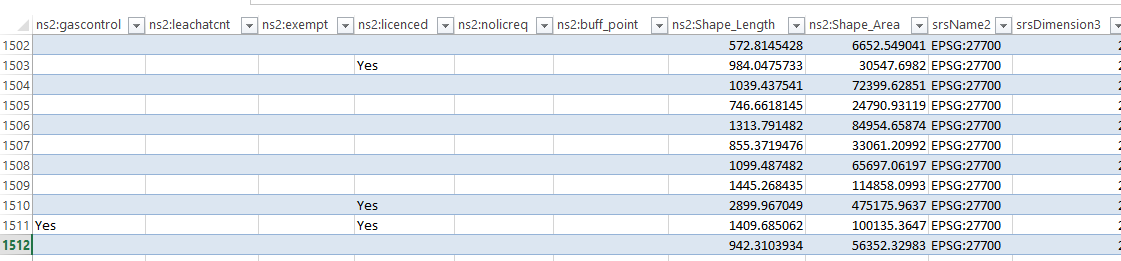
The lagoon appears at number 1512 on the list.
We get the actual correct address at column I.
But this is I am afraid where someone hit the delete button. No more detail on the site licence detail, SL31 and the renumbered WMHWU number 644/60 and subsequent EA permit number, WML 40803 respectively.
Missing basic info, if they cannot even give the site licence number, what are they trying to hide?
They also fail to name the site operator and licence holder, of course Albright and Wilson appear to have slipped their attention, and then of course “Rhodia Limited” did too!
More blanks in the 1512 column.
They actually do manage to give the EA region and area, which of course they must know, and also the OS number.
But once again, any legitimate info about the licence, such as when it was issued is omitted. This, as the EA do know was issued on 23rd January 1978. They also know, because they supplied me with the FOI request, as to when the last input of waste was added ! The waste was special waste, industrial and also contained liquid sludge.
There appear to be some very accurate, at least in terms of what they claim to be the shape and size of the site. So how if this detail is known to them, are the key facts about the licence supposedly not?
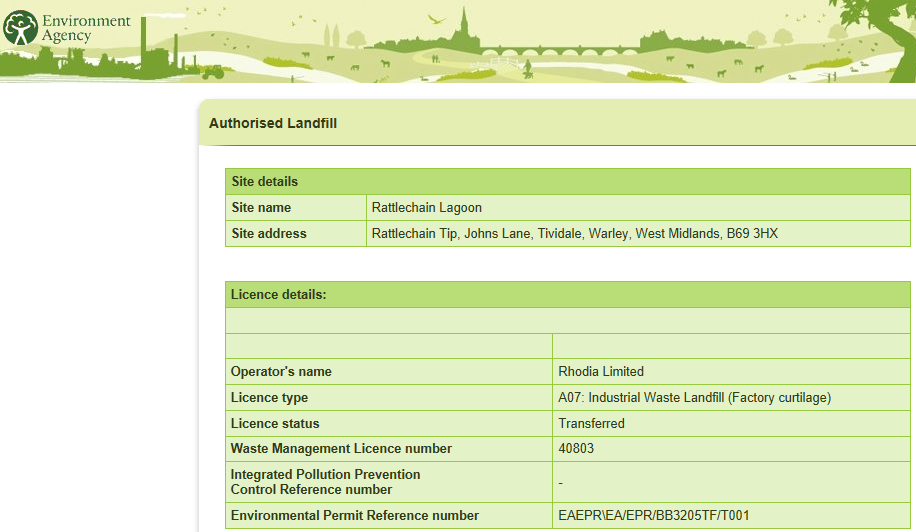
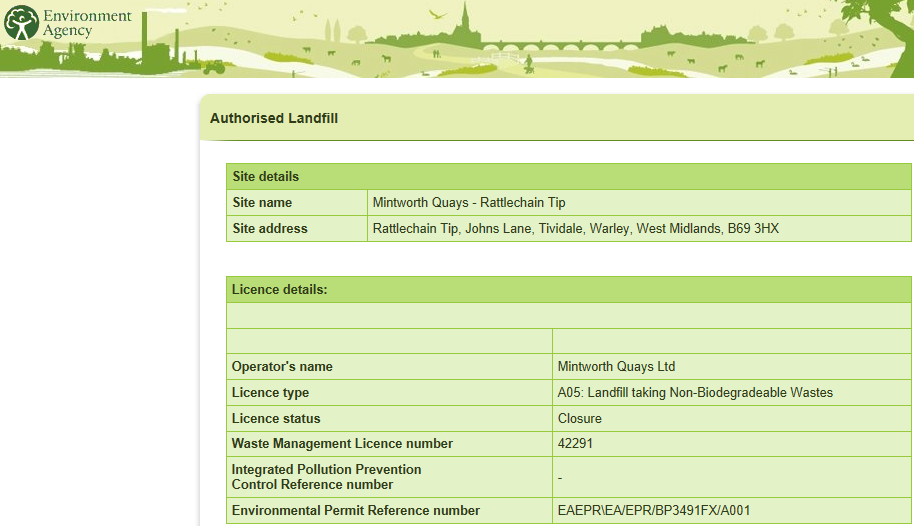
On the former EA website What’s in your backyard, this is a screenshot I took of what it then gave as the basic facts about real rattlechain tip, though it should be pointed out, they had at this time removed the detail about what toxic waste like white phosphorus had been dumped in there, replacing this with the obscure “factory waste curtilage”- which could of course refer to anything. THUS I THINK THAT WE CAN SEE HERE, A CLEAR METHODOLOGY TO BEGIN TO ERASE THE RECORDS THAT THEY HELD, AND REPLACE THEM WITH FIRST OBSCURITY, AND THEN DELIBERATE ERASER ALTOGETHER.
FAKE RATTLECHAIN TIP
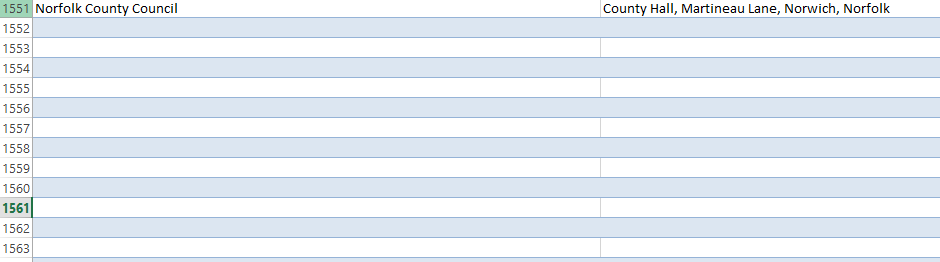
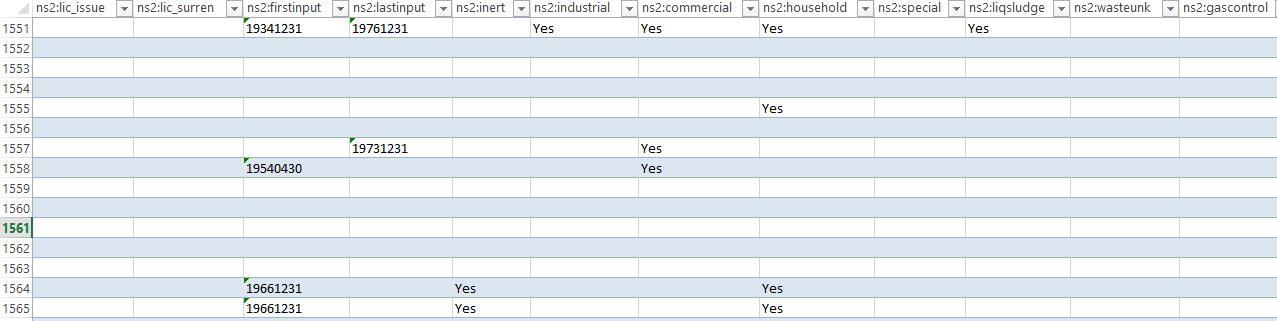
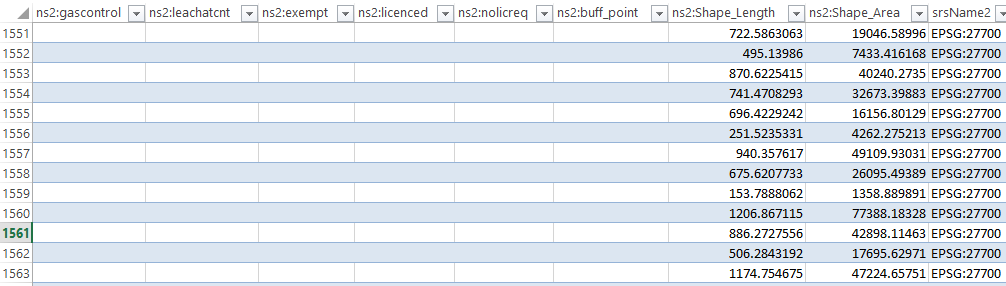
The Mintworth fiasco “rattlechain tip” is logged at 1561 on this list.
The address is given at Tipton Road Tividale.
Phoney rattlechain does not have any information as to who the site operator or address is.
The EA give details of the area once again and the OS number.
But also omitted is any detail of the site licence SL947. FROM THE INFORMATION WHICH THE EA SUPPLIED ME WITH, IE THE LICENCE IN AN FOI REQUEST, you can see that the date of issue was 23rd November 1992.
The EA therefore have this information, as well as all the modifications, as well as being able to tell me that the licence was never surrendered, only absolved with the phoney deception of “Mintworth Quays” going into voluntary liquidation- I would state for the very purpose of dodging having to surrender this licence.
The gas control measures consisted of the vent trench and the shite Christmas trees around the site perimeter, a longstanding argument between the EA and Mintworth’s consultants who thought that they knew better than the regulator, which extended the ludicrous “reclamation” scheme still further . The waste- tonnes of despoiling black foundry sand that blighted people’s windows and cars for many years, as evidenced by people’s direct objections to the length of the schemes; a “misery” which can be read HERE, as well as the crap from the sewage works development smeared into the workings on top of the Duport’s Tip foundations.
This is what the EA knew about this tip on the former What’s in my back yard website. Of course, not listed here are the considerable wastes that still remain in this Duport’s Tip, buried underneath the foundry sand, and exposed when a tatting operation for scrap metal was carried out ten years ago under the cover of heavy snow fall. Someone obviously needed some money for debts very damn quick. 😆 😆 😆
So what stunt are the Environment Agency trying to pull here? And who in this organisation are deleting information from the public realm? Do they intend to leave the Environment Agency at some point and set themselves up as “environmental consultants” where they can act as bitches for developers, having already carried out “the groundwork” of getting rid of difficult histories associated with buried hazardous wastes out of the public domain? It will obviously be put back into the public realm, by the likes of myself, and I would urge all environmental campaigners and those opposed to development in open spaces as well as health campaigners to keep a very close eye on what these dodgy civil servants are up to behind the scenes.
Posted inUncategorized|Comments Off on The Environment Agency- Erasing the wastes of history
By continuing to use the site, you agree to the use of cookies. more information
The cookie settings on this website are set to "allow cookies" to give you the best browsing experience possible. If you continue to use this website without changing your cookie settings or you click "Accept" below then you are consenting to this.